The single loudest fear I hear from first-time solo travelers isn't sleeping alone, or getting lost, or losing a bag. It's this: where do I eat. Not "what's the best restaurant" — the deeper one. "Will everyone notice I'm alone. Will I look sad. Will the waiter feel sorry for me."
I've eaten alone in 40 countries and I can tell you exactly none of those things happen. But knowing that doesn't help the first time you push open a restaurant door and see couples at every table. Here's the playbook that does.
Pick the right restaurant, not the right meal
The mistake is choosing the restaurant your travel guide raves about. That's usually a two-person-couple restaurant, low light, three-hour tasting menu, waiter who whispers. Skip it. Choose somewhere the food does the emotional labour so you don't have to. A bustling bistro. A trattoria at lunchtime. A ramen counter. A tapas bar. A Portuguese tasca. A Vietnamese bún bò place with plastic stools. The busier the room, the more anonymous you become. Nobody notices a solo diner at a ramen counter. Everyone notices one at a candlelit fine-dining restaurant.
The two-time-slots trick
Restaurants have three moods per shift: too empty (5:30–6:00pm), packed (7:00–8:30pm) and winding down (9:00pm onwards). Solo dining is easiest in the first and last windows. Early is casual: the staff has energy, the room hasn't filled yet, nobody is judging your table for two. Late is intimate: the room is quieter, the waiters relax, and locals often eat late anyway. The middle window is the only time solo dining can feel awkward, so simply don't go then.
The best seat is the bar (or the window)
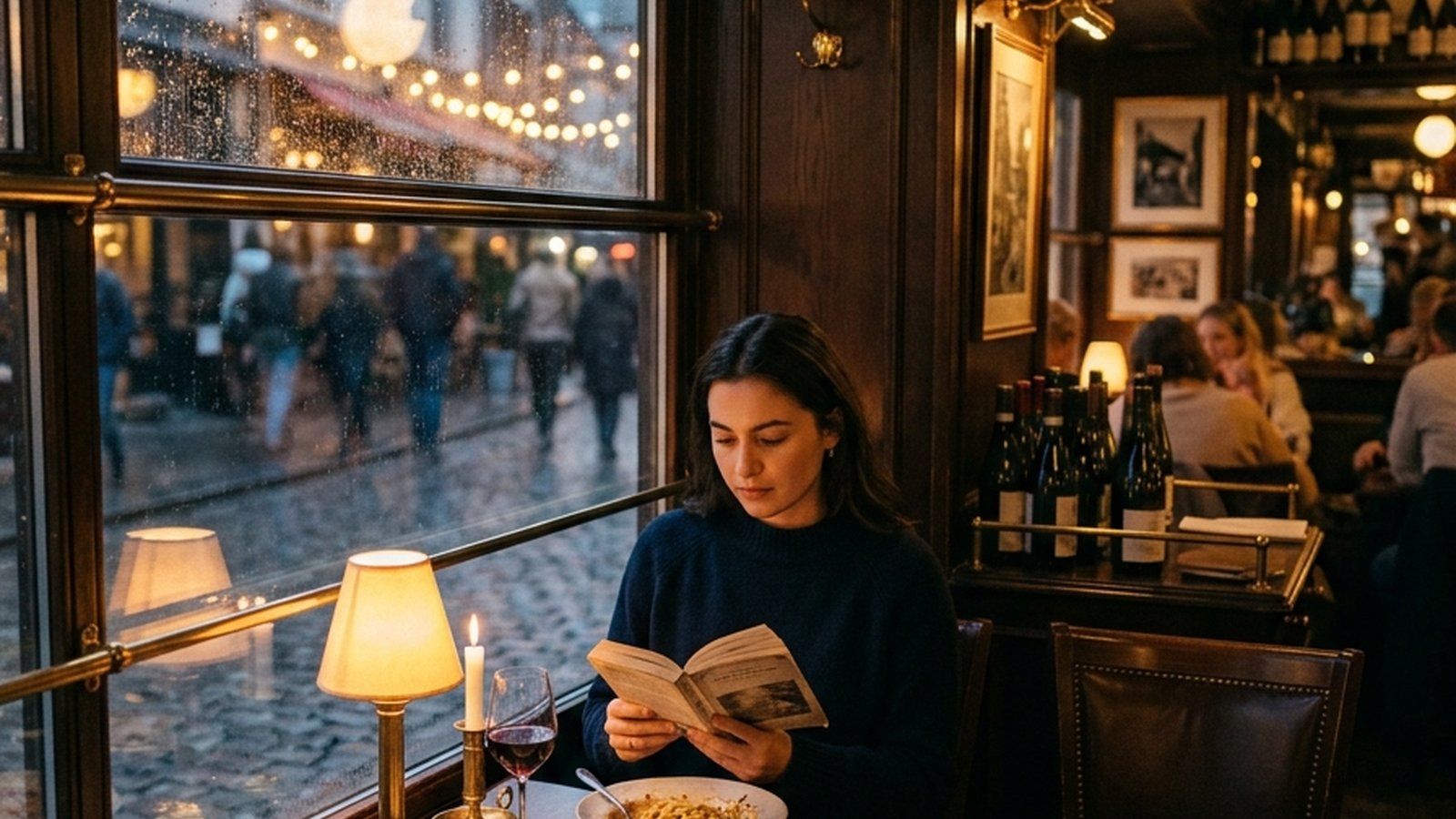
Ask for a bar seat if the restaurant has one. Bars are designed for solo humans — the chef is right there, the seat next to you is a normal transient neighbour, and there's always a view of something happening. If no bar, ask for a window seat: watching the street is the world's most polite conversation partner. A two-top wedged in the middle of the room is the worst possible position and the one hosts default to. Ask specifically: "Do you have a seat at the bar?" or "Could I take that window table?" Both are perfectly normal requests.
Bring one thing to look at, not five
You don't need to look busy — you need to look content. A single paperback is better than a phone. A phone is better than a laptop. A laptop is a signal that you are working through a meal, which reads as slightly sad. A book reads as chosen. If you're not a book person, a small pocket notebook works. Journaling a trip while eating is one of the highest-signal moments a traveler ever gets — food memory and place memory fuse together, and 30 seconds of notes will be a story you'll re-read for years.
Ordering in a language you don't speak
The scariest part of solo dining abroad, and the one thing that dissolves the moment you accept it: you will get it wrong occasionally, and that's fine. Point at things. Point at other people's plates. Use "recommend?" as a full sentence — every waiter on earth understands it. If you truly cannot decode the menu, say "please choose for me" (or the local equivalent), and let the kitchen surprise you. The best meals of my life have all come from that sentence.
Handling stares (and the ones you imagine)
You will feel watched for the first ten minutes of the first solo meal, and then you will never feel it again. That's not spiritual advice — it's just how novelty works in your brain. Once the meal starts arriving, the food does the anchoring. If anyone actually stares, it's usually a small child, and children stare at everything. Adults, statistically, are far too busy checking their phones to notice a stranger eating.
Ordering wine solo (without the theatre)
A single glass of wine is a completely normal thing to order. So is a half-bottle. Skip the pretence of "just water" — you're on holiday. If the wine list is intimidating, order the second-cheapest by-the-glass — restaurants price the cheapest to be the one they secretly don't recommend, and the second-cheapest is almost always the value pick. Or just point at another table's glass. Nobody will judge you. In fact wine staff love solo diners because it means real conversation instead of "we'll just take the house red."
Tipping, when you're alone
Tip the same percentage you would if you had company. Solo diners often over-tip out of guilt for "taking up a table" — you're not, that's not how restaurants work economically, and the correct tip is the local one. If you need a quick reference for local norms, save a note in your phone before the trip. It removes one micro-decision per meal.
Turning solo meals into rituals
The travelers who love solo dining have almost always turned it into a small ritual: a food journal, a receipt collection, a photo of the first bite, an audio memo of what the room sounded like. The ritual is what makes the meal yours. Otherwise the meal ends and disappears. Anything you don't capture is gone — see our piece on 50 travel journal prompts for lightweight structures that fit inside a five-minute post-meal moment.
Restaurants that are always kind to solo travelers
Some cuisines are structurally built for you. Ramen counters in Japan. Sushi bars. Spanish tapas bars (order two dishes, watch the room). Portuguese tascas. Neapolitan pizzerias at lunchtime. Turkish lokantas. Vietnamese phở stands. American diners. French brasseries at lunch. Chinese noodle shops. Israeli hummus counters. Korean pojangmacha tents. Twelve options — a lifetime of easy solo meals across the planet.
The pattern that solves it forever
The people who love solo dining aren't extroverts, and they aren't brave. They just learned that a good restaurant meal is a meal you noticed — the smell of the bread, the temperature of the wine, the light on the wall. Company is one way to notice, but it's not the only way, and often it competes. Alone, you notice everything. That's not a compromise. That's the point. The next trip is where you'll realise it — and if you want a portable version of every trick above, our Solo Diner's Playbook compresses this whole system into a printable one-sheet. It's on our resources page.