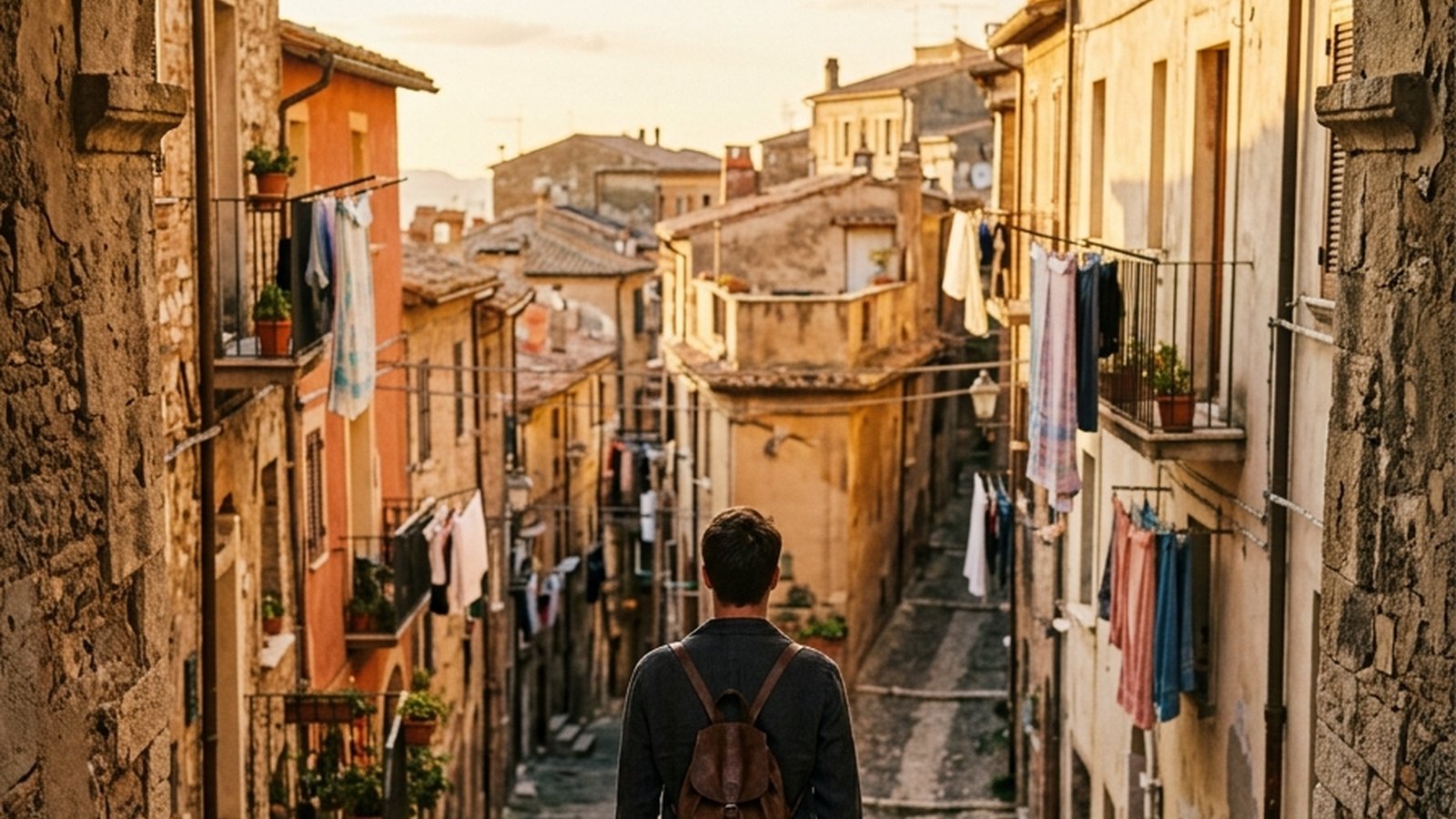
The best travel skill I've ever developed isn't planning better. It's the opposite. It's the practice of getting gently, intentionally lost. Not risky-lost. Not dramatically lost. Just lost enough that the phone has to go back in the pocket and the map has to be closed. It sounds like a small thing. It's the difference between a trip that felt like a trip, and a trip that felt like a to-do list executed in a foreign city.
The problem with modern travel
The default state of a traveller in 2026 is over-informed. Every restaurant is already reviewed. Every neighbourhood is already ranked. Every "hidden gem" is already featured on three lists. Google Maps knows where you are before you know where you are. TripAdvisor knows what you'll eat before you sit down. This is convenient. It is also, quietly, the exact opposite of travel.
The reason places used to feel more magical isn't nostalgia. It's that we didn't know what was around the next corner. Corners still work the same way — they still hide things, still surprise, still contain the entire quality that makes a city feel like a city. But you have to close the phone to find them.
The definition of "productively lost"
Productively lost isn't reckless. It's not walking into a rough neighbourhood at midnight without a plan. It's not turning off your phone in the middle of nowhere. It's the following, more mundane thing: you know roughly where the hotel is, you know roughly which direction "back" is, you have enough phone battery to solve any real problem, and you have decided to take the next 90 minutes without looking up anything in advance. That's it. That's the whole practice.
How to actually do it
Pick a starting point — anywhere. A café, a park, a train station. Look up briefly to note which direction the water is, or the big landmark, or the tourist zone (so you can navigate back by geometry, not GPS). Put the phone in a pocket you have to consciously reach into. Walk. When you get to a fork, pick the one that looks more interesting. When you don't know which is more interesting, pick left. Repeat.
The rule is simple: for 90 minutes, no looking things up, no reading reviews, no photo research. If a restaurant looks good, walk in. If a small park is quiet, sit down. If a bookstore is open, browse without buying. If you see something you don't understand, don't Google it. Note it. Keep walking.
What you'll find
You'll find things that aren't on any list. A courtyard behind a laundromat. A tiny gallery run by an old man who's been there since 1974. A viewpoint that costs nothing. A café with the best croissant in the city, occupied entirely by grandmothers. A church that's open only on Wednesdays. A neighbourhood that no tourism guide mentions because it's not exceptional — it's just lived-in, which turns out to be the thing you wanted anyway.
You'll also find the shape of the city. Not the Google Maps shape — the felt shape. Which street rises. Which street falls. Where the light hits in the afternoon. Where the wind comes from. Where the older buildings cluster. This is knowledge nothing else can give you.
The mental shift that unlocks it
The block for most people isn't fear of being lost — it's fear of "wasting" time. The internalised belief that if you didn't optimise the visit, you failed the trip. This is the deepest travel trap and the hardest one to notice, because it feels like being responsible. But the trip you optimise is the trip you remember as a checklist. The trip you get lost in is the trip you remember as a story.
Nothing about a wandering hour is wasted. It's the point.
What to do with the phone
Not "leave it in the hotel" — that's fake advice. You need it for the taxi home. You need it for emergencies. What you need to disable is the reflex to reach for it every 90 seconds to check where you are. One useful trick: keep it on, keep it in your pocket, but decide before you leave that you won't open it unless something is actually wrong. Not "unless I'm not sure where I am" — that's the whole point. Only if something is wrong.
For memory, though, the phone helps if used sparingly: a voice memo when you find something. A photo when you want to. A pin dropped on a map so you can find the alley again. Our journal-offline piece is basically the toolkit for this.
How long to be lost
Ninety minutes is the sweet spot. Under an hour and you'll rush through the discomfort before it converts into curiosity. Over two hours and you'll get physically tired, which is a different mode altogether. Ninety minutes lets you cover roughly a neighbourhood at wandering pace, discover 3–5 unexpected things, and return to the hotel with a small buzz of contentment that no algorithm could have designed for you.
Doing it in the wrong places
A few notes of honesty. Getting lost is a warm-climate small-old-city practice — it works beautifully in Lisbon, Kyoto, Rome, Kraków, Hanoi, Havana, Marrakech. It works less well in cities that are structurally hostile to pedestrians (large parts of American suburbs, some newer Asian megacities). It works badly at night in unfamiliar countries — save it for daylight. And it works terribly with someone who's anxious about being lost, which turns 90 minutes of joy into 90 minutes of low-grade conflict.
The one paragraph
Getting lost on purpose is the antidote to the over-optimised trip. Pick a starting point, note the direction of "home," pocket the phone, walk 90 minutes without lookups. Take the more-interesting turn. Sit in the small park. Buy the pastry. Don't Google what you don't understand. Come back with a story. Do this twice per trip and the trip is different forever.
The world you can only find without a map is still there. It's just quieter now, waiting for the corners the algorithms don't route through.