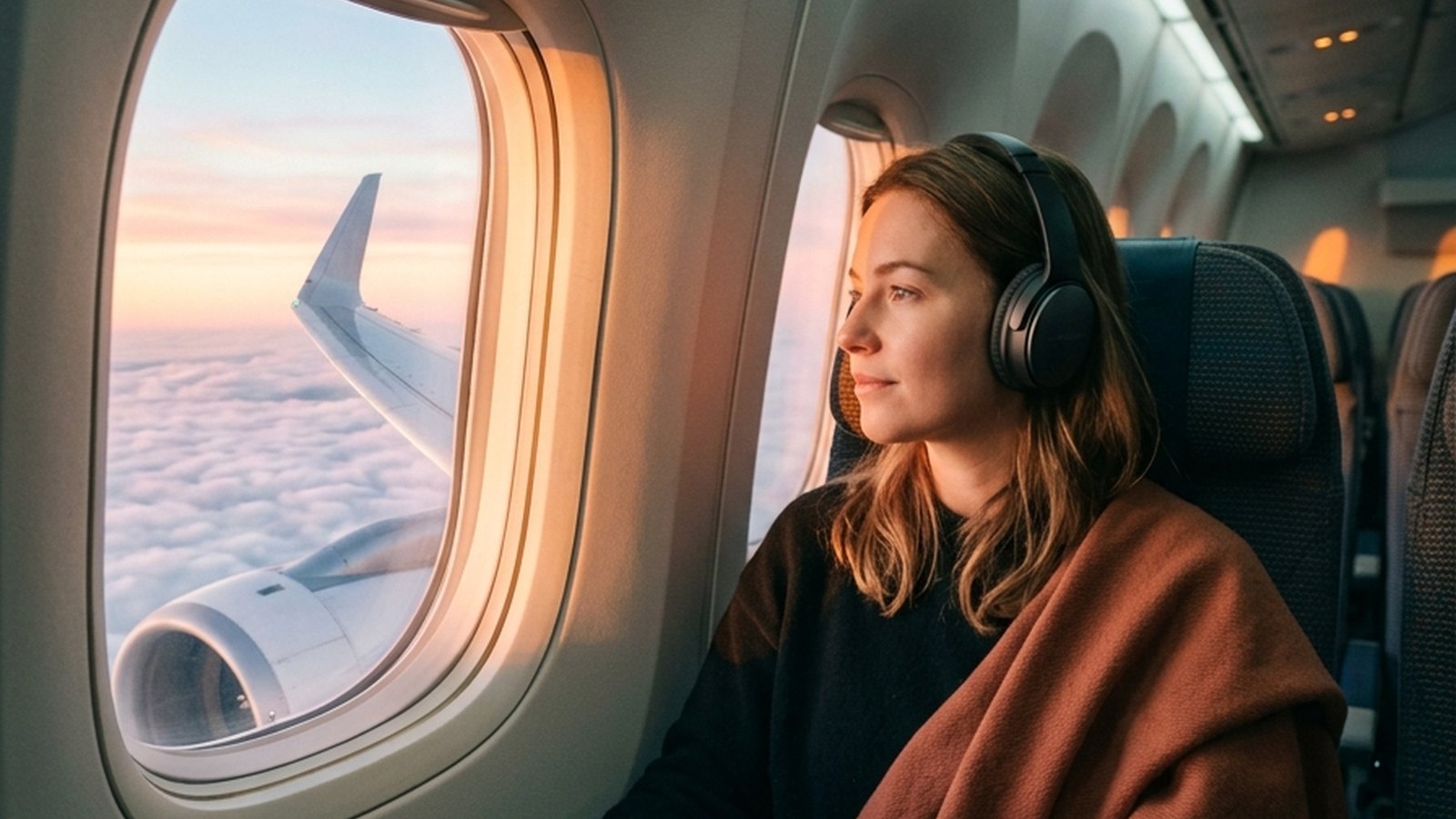
Almost everything published about jet lag is either folklore or ad copy. The pills, the special glasses, the "hack your circadian rhythm in 12 hours" apps — after 10+ long-haul trips across every direction that matters, I can tell you the honest truth: jet lag isn't hacked, it's respected. What follows is the residue of a decade of trial and error. It's short because most of it doesn't need to be long.
The one variable that dominates everything: direction
Eastbound flights (US → Europe, Europe → Asia, US → Australia) are roughly twice as hard as westbound. Westbound, you're staying up later than usual — your body was going to do that anyway on a Saturday night. Eastbound, you're going to sleep hours before your body is ready, which it will refuse. Every plan below is skewed for direction. If you only remember one thing: westbound is a mild inconvenience; eastbound is a real project.
The pre-flight sleep bank (works, but nuanced)
Sleep-banking — sleeping longer for two nights before a big flight — genuinely helps. Not because it "stores" sleep (nothing does), but because it lowers the sleep pressure you carry into the flight, meaning you'll actually sleep on the plane instead of just closing your eyes. The trap is treating the day before as normal. It isn't. Shift your bedtime toward your destination time zone by an hour if flying east. Even that small shift matters.
Hydration is the boring answer that keeps being right
Cabins are drier than the Sahara — literally, humidity often sits under 10%. Even minor dehydration masquerades as jet lag once you land: headache, fog, low mood. Two litres of water on any flight over 6 hours. This is where solo travellers fail most, because they don't want to keep asking for water. Take a 750ml bottle empty through security, fill it at the fountain past the gate, and refill from the crew. Say "thank you" enough times that they smile — it works.
The cabin movement micro-routine
Every 90 minutes of a flight over 6 hours: stand, walk to the back, do 60 seconds of calf raises and shoulder rolls, drink water, sit down. That's it. Circulation is the number one physical variable in how you feel when you land, and it's astonishing how few people move once they've reclined. A cheap timer on your phone (offline) prompts it. Your legs will thank you at baggage claim.
Blue-light protocol on descent
Two hours before you're due to land — regardless of what time it is where you took off — start living on the destination time zone. If it's morning at destination: open the shade, get bright light, drink coffee, order breakfast, put on a podcast. If it's night: dim everything, put on warm-tone glasses if you have them, no screens above dim, no coffee. This is the single most under-used trick in travel wellness and it's completely free.
Food timing is a bigger lever than food choice
What you eat on a flight matters far less than when. Studies (Northwestern's Fuller lab has good data on this) show that eating at destination-time meals cues your circadian rhythm nearly as strongly as light exposure. If it's dinner at destination, eat dinner. If it's 3am at destination, skip the tray and sleep through. Politely decline the meal service — it's the single easiest habit change that produces the biggest arrival-day energy.
Melatonin, without the myths
Melatonin is a signalling molecule, not a sleeping pill. It tells your body it's night. It doesn't force sleep. The right dose is small (0.3–1mg is more effective for phase-shifting than the 5–10mg tablets most stores sell), taken 30–60 minutes before your target destination bedtime, for 2–3 nights after arrival. Larger doses just make you groggy without shifting your rhythm faster. If you're pregnant, on antidepressants, or under 18, skip it entirely and rely on light exposure instead.
Caffeine's real half-life is longer than you think
Caffeine has a half-life of about 5 hours. A 10am espresso still has meaningful caffeine in you at 8pm. On a long-haul trip your ability to sleep at the new bedtime is your most valuable resource, and afternoon coffee is the fastest way to lose it. Rule of thumb: no caffeine within 8 hours of destination bedtime for the first 3 days after arrival. This one habit shifts arrival week from "wrecked" to "functional".
Arrival-day light exposure schedule
Sunlight is the strongest circadian input by a factor of 100. On arrival day: aim for 30 minutes of outdoor light within 2 hours of local waking time, whatever that is. Walk if you can. If it's grey, still go — cloudy daylight is 10× brighter than the best indoor lighting. Skip the hotel gym; that's evening. Morning light is what re-anchors your body clock. The mistake most people make is arriving at 8am and sleeping "just for a couple of hours" — that couple of hours ruins the whole first night. If you must nap, cap it at 20 minutes.
The 3-day arrival ramp
Don't plan a 7am morning meeting for the day after you land. Don't plan anything cognitively demanding for the first 48 hours. Recovery follows a predictable curve: Day 1 you feel oddly OK on adrenaline, Day 2 is the worst, Day 3 is a real turning point, Day 4 is normal. Structure your itinerary around this. Big city, museums, easy dinners for the first three days. Adventures start Day 4. This one piece of scheduling wisdom saves entire trips.
Walking is a jet-lag drug
Every trip I've had a good first week on, I walked 15,000+ steps on Day 1. Every trip I collapsed into a taxi and hid in a hotel, I paid for it in Day 2 exhaustion. Walking combines the three most powerful jet-lag interventions in one activity: light, movement, meal timing (you get hungry at the right moment). If you do nothing else on Day 1, walk somewhere flat, for a couple of hours, ideally near water.
What to carry offline (and why it matters)
The one thing that's ruined more first-day arrivals than jet lag is a dead phone with a boarding pass, hotel address, and taxi app all trapped behind a signal. Save your first-day schedule, hotel address, and airport transfer plan somewhere that opens without a network. If you need a broader framework for this, see our how to plan a trip without internet guide — it's built for exactly the "just landed, half-alive" state you're describing.
The one paragraph summary
Bank sleep. Hydrate ruthlessly. Move every 90 minutes. Live on destination time from two hours before landing. Get outdoor light within two hours of your first waking. Walk a lot. Cap the naps. No afternoon coffee. Give yourself three days. Don't try to hack it — respect it. That's the whole system. A printable one-page version lives in The Slow Traveler's Wellness Kit on our resources page.