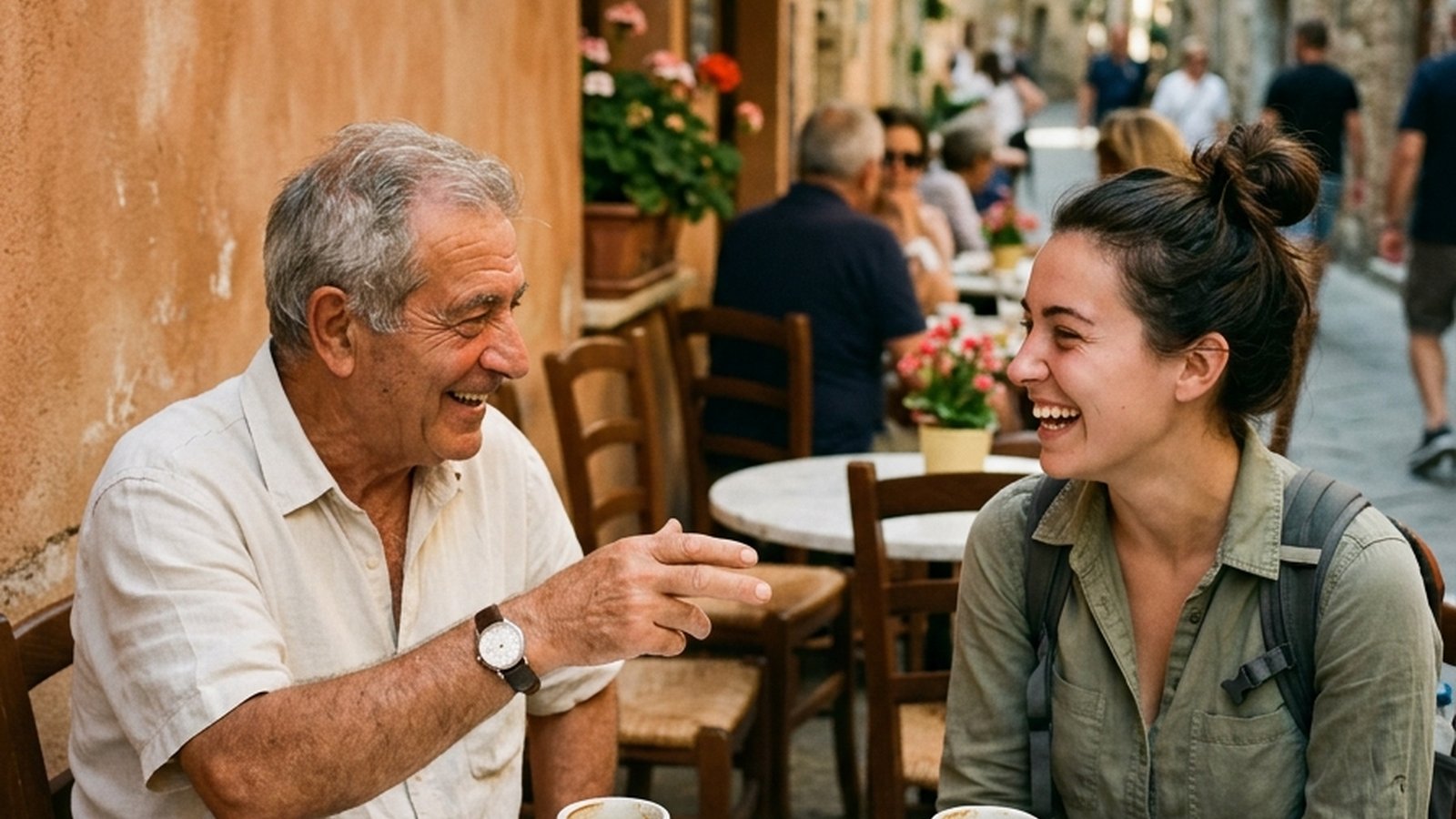
Some of the best conversations of my life have happened with people I couldn't say a full sentence to. A grandmother in a village in Georgia. A boatman on the Mekong. A grocer in a tiny town in Puglia. None of us shared more than about ten words. All of us walked away smiling. If you've ever thought "I couldn't travel there, I don't speak the language" — you're wrong, and it took me a decade to figure out why.
The single mental shift that changes everything
Stop trying to communicate information. Start trying to share a moment. Most tourists open with "how do I get to the train station" — a request, in a language nobody there speaks, delivered with the anxiety of someone who needs an answer. The person opposite you feels the pressure and freezes. Reverse it: open with a smile, a gesture, a compliment on the space you're in. You've reset the stakes. Now the conversation can be a game instead of a transaction.
The three magic words that work everywhere
"Hello", "thank you", and "please" in the local language. That's it. Twenty seconds of pre-flight learning per country, and it changes every interaction you'll have for the entire trip. Locals notice immediately — not because the pronunciation is good (it usually isn't) but because you tried. Every human on earth understands the difference between someone who tried and someone who didn't. The trip splits into two worlds after those three words.
The "I don't speak…" opener
Learn one full sentence in every language you visit: "I'm sorry, I don't speak [language], do you speak English?". This one line disarms every awkward opening. It shows respect, humility, and hands the linguistic power to the other person. About 40% of the time they'll say "a little", and now you're both in a game with rules. The other 60% they'll shake their head and now you can move to the next tool.
Gestures are underrated because we're embarrassed to use them
Point. Mime. Draw. Every child on earth knows how to communicate with 30% words and 70% body. Adults forget. The unspoken rule of cross-language travel is: the more physical you're willing to be, the better it goes. Point at menus. Draw a train on a napkin. Mime "small" and "big" with your hands. The self-consciousness lasts about 90 seconds. Then it becomes fun.
Phones are a bridge, not the entire path
Translation apps are miracle tools when used sparingly and disasters when leaned on. If every question is typed into Google Translate, the conversation loses its life — you're both staring at a phone. The trick is handoff mode: try in your best broken local words first, get 60% of the way, then use the app to fill the gap. Show them the phrase. Let them read. Then put the phone away. They'll respect the effort and the app becomes a punctuation mark, not the whole sentence.
Food is the universal solvent
You cannot mess up a meal-related conversation. "This is delicious" translates through a smile, a hand on the chest, a slow nod. Ask what a dish is called. Point at another table's plate. Compliment the cook. Nine out of ten times the person you talked to will bring you something they didn't charge for. This isn't a hack — it's what happens when you show genuine curiosity in someone's craft. The solo dining piece we published this month is deeply connected — solo diners get more of these moments than anyone else.
Numbers and money — the two you must memorise
Learn 1–10 in the local language. Twenty minutes on the plane covers it. It transforms markets, taxis, tips, ordering — every price becomes a conversation instead of a screen. Second: learn the currency name. Nothing signals tourist louder than referring to money as "the local currency". Nothing endears you faster than saying "how many lira" or "dinar" like it's normal.
The please-repeat-that phrase
Learn one phrase for "again, slowly, please." In Spanish it's "otra vez, despacio, por favor". In Italian "un'altra volta, per favore, piano." In Japanese "mō ichido, yukkuri onegaishimasu." Whichever country you're in, this one phrase turns 30-second panic into 30-second conversation. It's an invitation, not a surrender.
Compliment the place, not the country
"Your city is beautiful" beats "your country is beautiful" every time. Cities have personalities and locals feel pride at the city level. Country compliments feel generic and geopolitical. Learn how to say the specific place is beautiful — Rome, Kraków, Kyoto — and mean it. The response will surprise you.
The goodbye hierarchy
Every language has three levels of goodbye: casual, warm, and formal. Using the warm one to a shopkeeper you've spent 10 minutes with — even if the pronunciation is imperfect — is one of the small acts of travel that stays with people. It's why they wave you into the street. It's why you remember the shop, and they remember you.
Emergency phrases every traveler needs
Save these to your phone, offline, before you fly: "I need help", "police", "hospital", "embassy", "I don't feel well", "where is the toilet". Write them out phonetically so you can say them under stress. This is one of the reasons every trip document — including phrases — should be accessible offline. If your phone is dead you can't Google Translate. Our piece on what to do when your phone dies abroad covers the wider survival kit.
Silence is a conversation move, too
When words run out, don't panic. Smile. Nod. Let the moment breathe. Some of my most-remembered "conversations" abroad were 90% silence with 10% pointing at things. Silence with a stranger who wants you to feel welcome is one of the warmest things travel can produce.
What always fails, and why
Speaking English louder never works — a fact so obvious it shouldn't need saying, but I've watched grown adults do it in three continents. Neither does speaking English faster, weirdly a similar reflex. Neither does asking directions from someone who is on the phone or eating. Wait until they're free, then approach with respect. The mistake isn't the language. It's the tone.
The system in one page
Hello, thank you, please. "I don't speak…" opener. Gestures without embarrassment. Handoff mode on the phone. Food as universal solvent. Numbers 1–10. Please-repeat-slowly. Compliment the place. Warm goodbyes. Emergency phrases saved offline. That's the entire system, and it's genuinely enough to travel most of the world with real, warm, memorable connections. A printable pocket version is bundled in The 25-Phrase Traveller's Language Cheat Sheet on our resources page.